
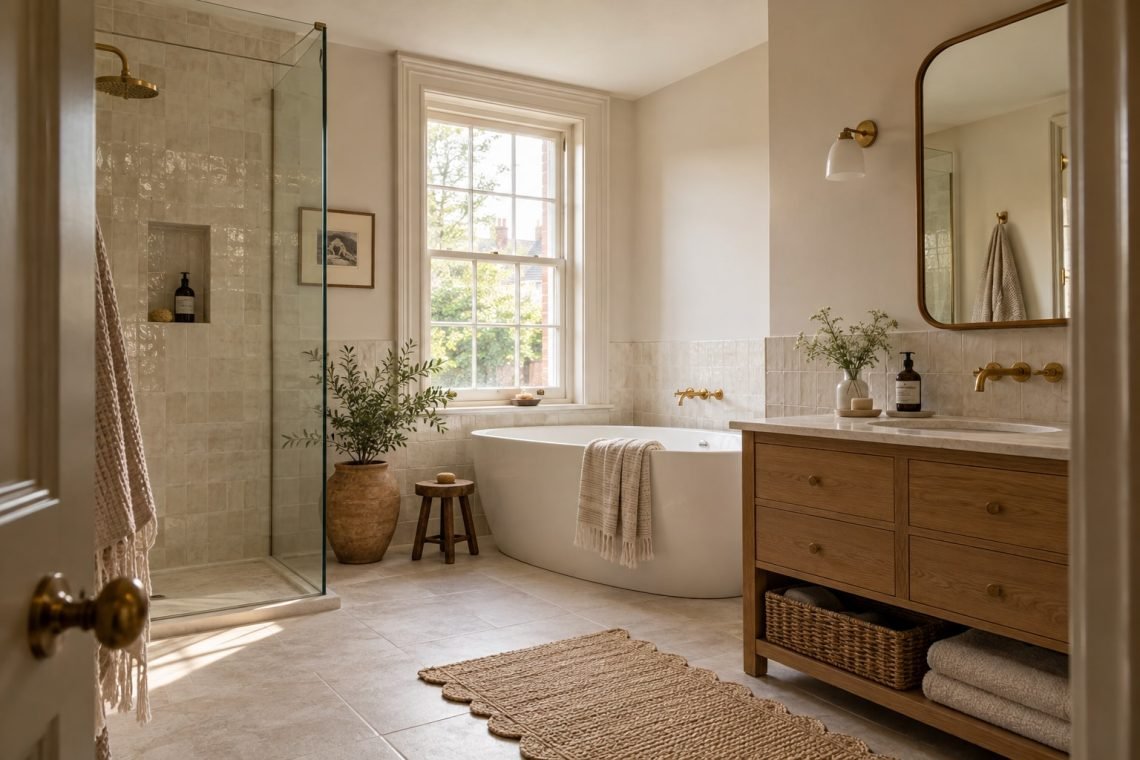
A warm neutral bathroom doesn’t have to be beige from floor to ceiling. In fact, the rooms that feel most inviting usually mix a few different tones: milky white, pale wood, soft stone, a little brown and something with a lovely uneven texture.
The trick is giving those quiet colours enough contrast to feel interesting. These warm neutral bathroom ideas range from small changes you can make with towels and accessories to finishes worth considering during a renovation. Pick a few that suit your room rather than trying to include all twelve.
As an Amazon Associate I earn from qualifying purchases.
Images are AI-generated styling ideas, not photographs of the linked products. Amazon links let you browse similar items; check dimensions, materials and suitability before buying.
1. Start with a white that feels soft in your room
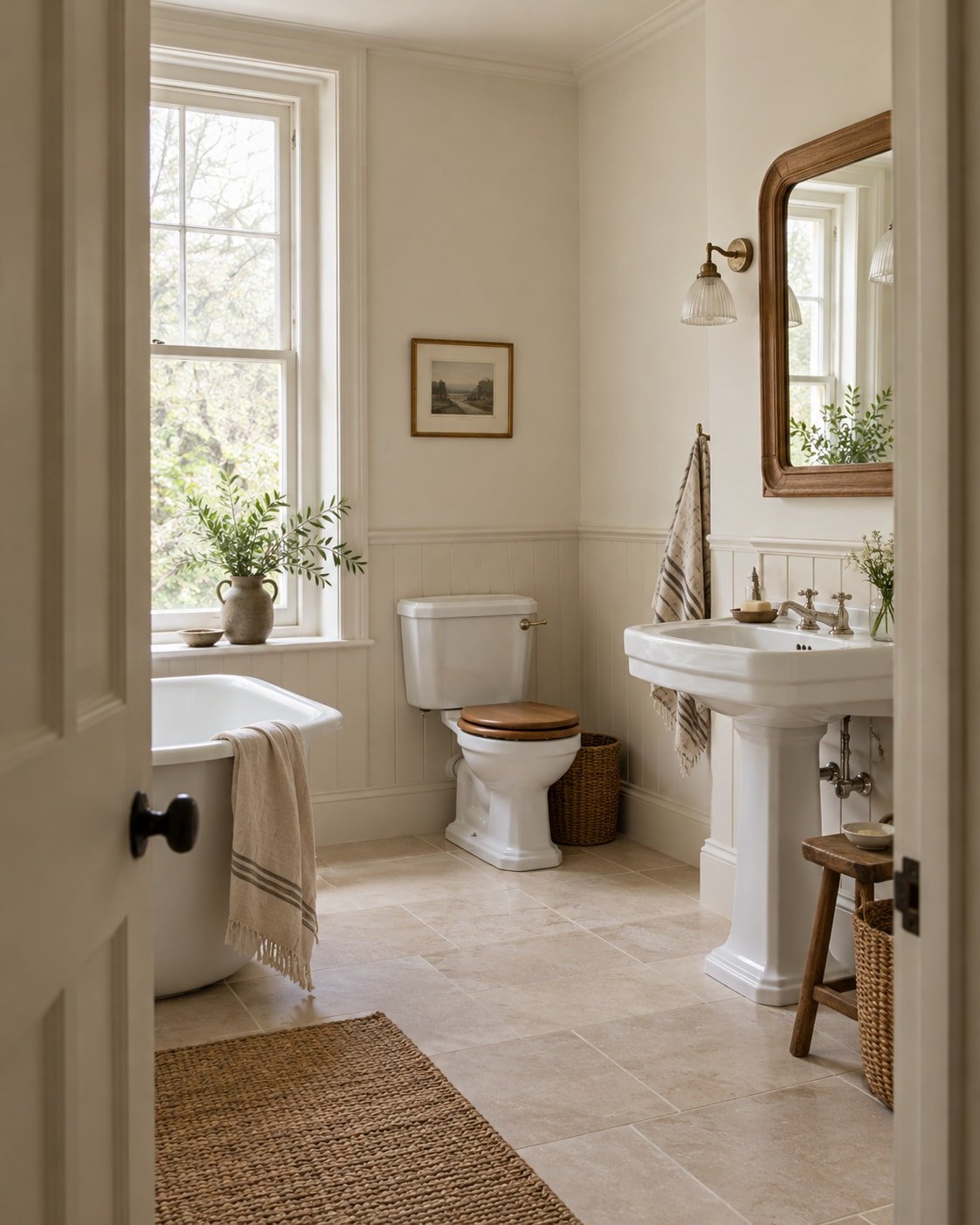
White can still belong in a warm palette. A softer shade often sits more comfortably with wood, woven details and creamy tile than a very sharp, blue-looking white.
Test a few samples beside the finishes you are keeping. A colour that looks perfect on a screen may behave differently next to an existing bath, under your bulbs or in a room with little daylight. View the samples in the morning and after dark before committing. For painted bathroom walls, choose a finish suitable for the room and follow its preparation instructions.
Look for the undertone that connects the room rather than choosing the paint in isolation. A cream tile may make a very pink white feel stronger, while an existing grey floor can change how a yellow-toned shade reads. In a warm neutral bathroom, a gentle bridge between those fixed finishes is often more convincing than choosing the warmest white on the sample card.
A useful starting point: Keep the existing sanitaryware in view when comparing samples; it is part of the colour palette too.
2. Let a wood vanity do some of the warming up
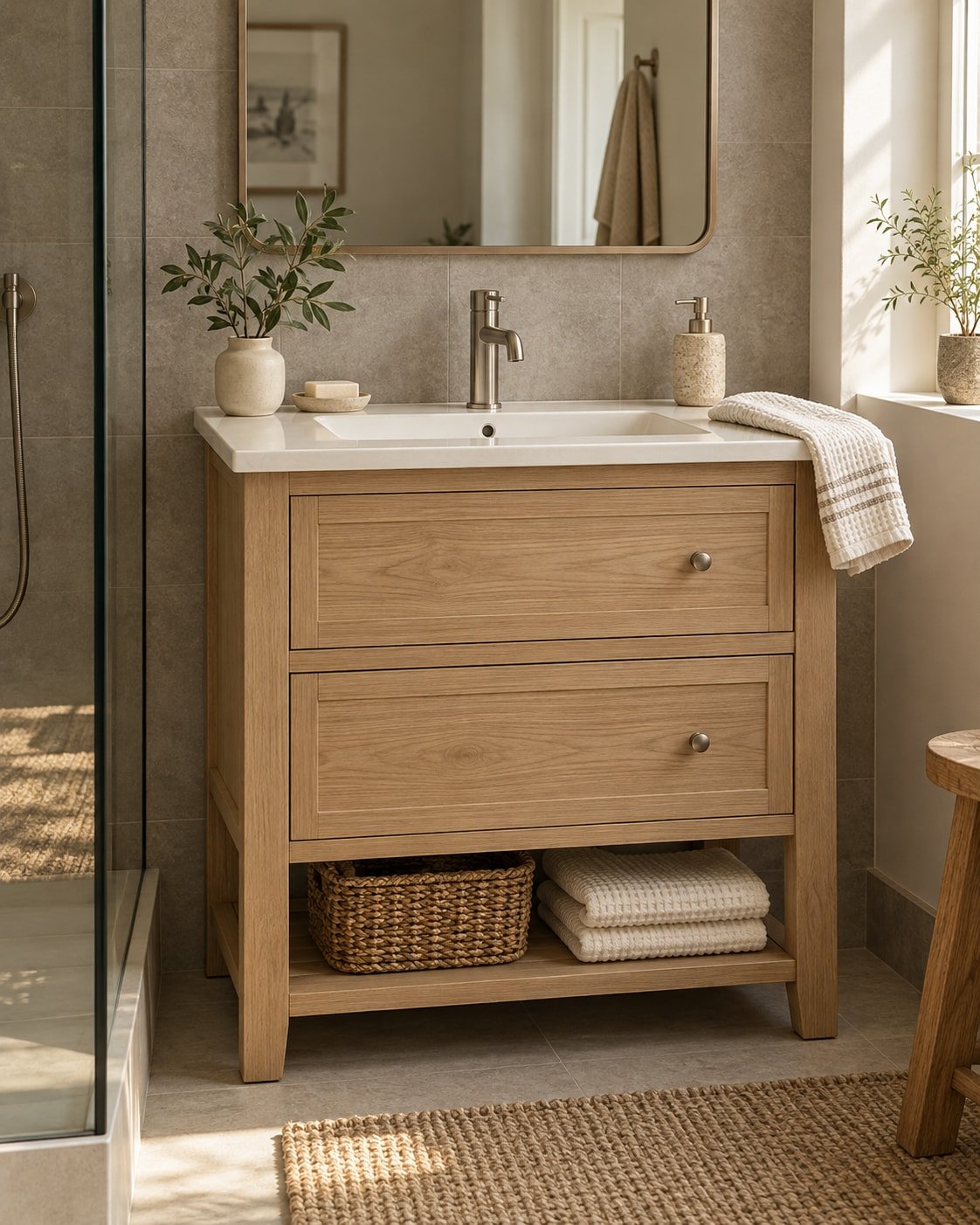
A wood-toned vanity gives a neutral room an immediate focal point. The grain adds movement, so the rest of the finishes can stay fairly simple without looking flat.
Think about undertones as well as the species or finish name. Pale oak, honey-coloured timber and darker walnut each change the mood. In a small bathroom, a modest vanity with useful closed storage may work harder than a beautiful open shelf that leaves every spare bottle on display. Choose bathroom-suitable construction and check the care guidance.
Before falling for a particular vanity, map out the storage you need inside it. A shallow drawer for daily toiletries and a deeper space for spare towels may be more useful than a large cupboard without divisions. Check that doors and drawers have room to open beside the toilet or shower, so the wood becomes a practical improvement as well as a decorative one.
A useful starting point: Repeat the wood tone once—in a mirror or small accessory—rather than matching every item.
3. Choose texture instead of another colour
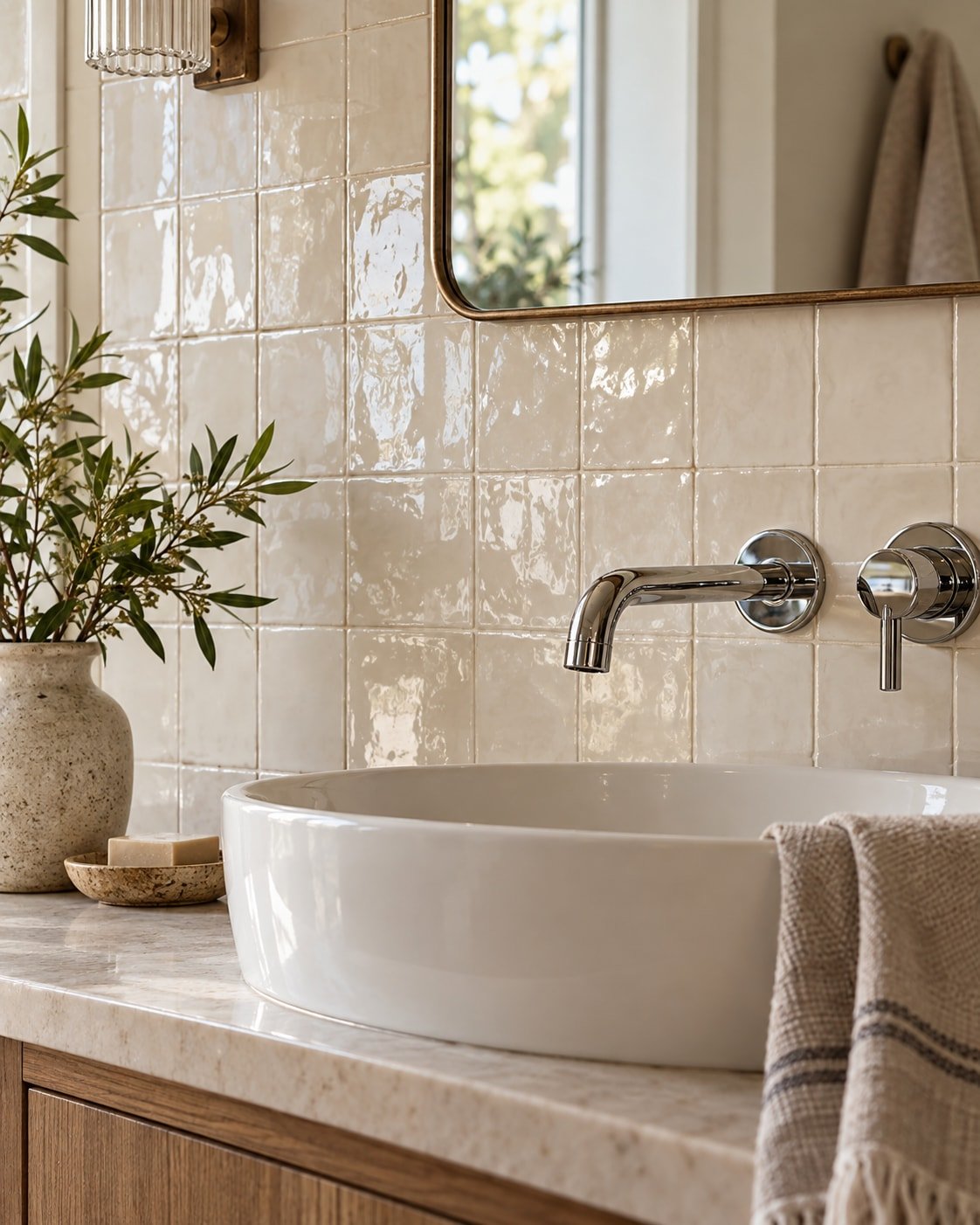
If you like a restrained palette but worry it will look plain, texture is your friend. A softly rippled tile, subtle glaze variation or a slightly uneven-looking surface can make cream feel much richer.
A small sample rarely tells the whole story, so look at several tiles together where possible. Notice how much variation there is and how the grout changes the effect. A close grout colour gives a softer field of texture; a stronger contrast makes the individual shapes more noticeable.
Think about texture at different distances. Subtle glaze variation can look beautifully quiet from the doorway yet still give you something interesting to notice beside the basin. In a warm neutral bathroom, that small change in surface is often enough. There is less need for a dramatic pattern when light can move across a gently textured wall throughout the day.
A useful starting point: Use textured tile in one clear area so it feels considered rather than visually busy.
4. Layer cream, oatmeal and taupe

You don’t need every neutral to be identical. Cream, oatmeal and taupe can sit together beautifully when there is enough difference between them to look deliberate.
Start with the largest fixed finish, then add a lighter or darker textile. For example, oatmeal towels against a cream wall are more interesting than trying to match the wall exactly. Keep one tone dominant and let the others support it. This is an easy way to test warm neutral bathroom decor ideas before changing any permanent finishes.
Separate similar shades with different materials so the combination feels intentional. A smooth cream basin, a woven oatmeal basket and a taupe towel have enough variation even when their colours sit close together. If everything has the same flat finish, the palette can look accidental. Try removing one piece before adding another colour; a simpler arrangement often lets the remaining textures stand out.
A useful starting point: Put the actual towels and bath mat together in the room before deciding whether their undertones work.
5. Use warm metal as a small accent

A little warm metal can lift a room full of pale surfaces. A towel ring, mirror edge or cabinet handle gives the eye a place to land without bringing in a strong colour.
You don’t have to replace perfectly good taps to try the idea. Begin with an accessory and see how it sits beside the existing finish. If you do buy several brass-toned pieces, compare samples or finish descriptions carefully; warm metals can range from pale champagne to quite orange.
Use the metal where it will be noticed in everyday views. A warm-toned handle against a pale cupboard can have more effect than several accessories crowded around the sink. For a warm neutral bathroom with existing chrome taps, introducing one other finish in a small, repeated way can feel more relaxed than attempting to replace every visible fitting at once.
A useful starting point: A few repeated accents usually feel calmer than adding a new metallic finish to every surface.
6. Bring in a little clay or terracotta

Clay tones are useful when a neutral bathroom needs a little life. A terracotta-coloured pot or soap dispenser adds warmth without making the room feel suddenly colourful.
Keep the amount small at first. One earthy piece often works better than a complete matching set, especially in a compact room. Choose accessories intended for bathroom use and place porous decorative pieces where they will stay reasonably dry. The colour can do the work even if the item itself isn’t made from terracotta.
A clay accent can also connect a cool-looking surface to warmer textiles. Place it near a stone-coloured tile or a plain white basin and see whether the surrounding shades feel more balanced. If the orange undertone looks too strong, try a dustier rose-brown instead. You are looking for a quiet connection between materials, not a colour that takes over the room.
A useful starting point: Try the accent next to your towels: clay and oatmeal are a particularly gentle combination.
7. Soften the light around the mirror

Cool, harsh light can change the feel of even the loveliest warm finishes. Soft-looking light around the mirror helps the room feel more comfortable when daylight has gone.
Look at the whole arrangement rather than just the shade. The position, brightness and colour of the light all matter. Keep enough useful illumination for everyday routines, and choose fittings suitable for their exact bathroom location. A qualified electrician can advise on local requirements and any hardwired changes.
Judge the mirror lighting while standing where you actually get ready. A pretty fitting that leaves your face in shadow may need a different position or a more useful spread of light. Warm neutral bathroom ideas should still work for brushing teeth, shaving and applying skincare. Let atmosphere support those routines instead of making the room so dim that everyday tasks become awkward.
A useful starting point: Check how your tile and paint look under the proposed light before buying all the fittings.
8. Warm up an empty wall with a wood shelf

A narrow wood shelf can break up a blank wall and give you a useful home for everyday things. It is especially helpful in a small bathroom where adding another cupboard would feel heavy.
Keep the arrangement practical: a couple of folded towels, a lidded container and some breathing room. Choose a shelf and fixings suited to the wall and the conditions, and avoid putting moisture-sensitive pieces where they will be repeatedly splashed. The point is a warmer room, not a display you have to rebuild every morning.
Decide what the shelf will hold before choosing its depth. A place for folded hand towels needs different proportions from a ledge for a soap refill and small jar. Use a piece of card to test how far it projects into the room. Above a narrow walkway, keeping the shelf modest can preserve the open feeling that made it appealing in the first place.
A useful starting point: Leave enough clear space to take things off the shelf without knocking the rest over.
9. Add a softer layer at the window
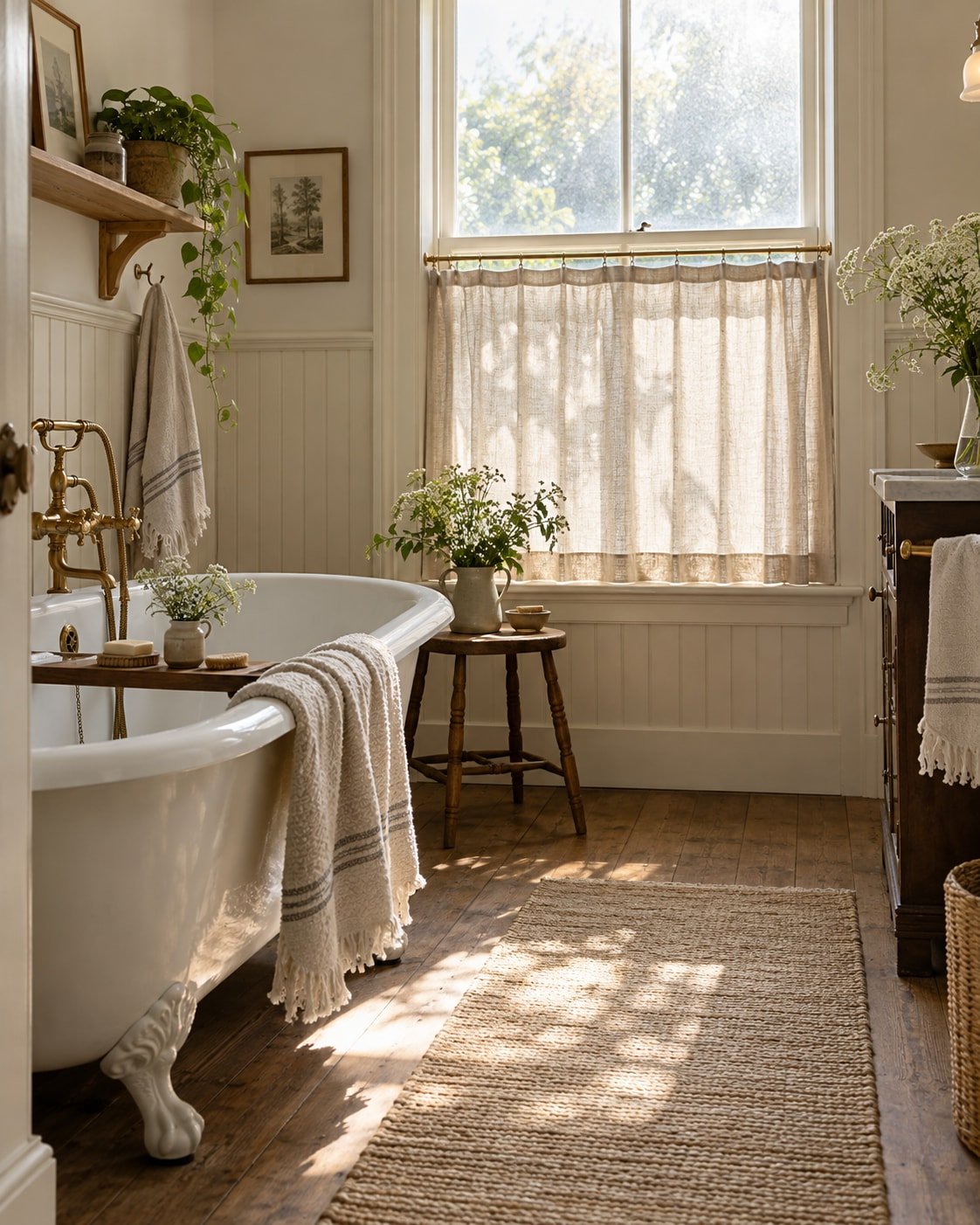
A plain window treatment can soften all the hard surfaces in a bathroom. A linen-look blind or café curtain brings texture without asking the walls or floor to do anything new.
Choose it around privacy, ventilation and how close the window sits to water. Fabric that works beside a dry vanity may be impractical directly next to a shower. A washable option is often easier to live with, and pale oatmeal can feel softer than another bright-white surface.
Look at the fabric in daylight before deciding on its colour. A loosely woven material may appear much lighter when the sun comes through it, and the same curtain can look more solid after dark. For a warm neutral bathroom, a little visible texture adds softness without a busy print. Check privacy in the conditions when the bathroom will actually be used.
A useful starting point: If fabric isn’t practical, bring the same softness into towels and keep the window treatment simple.
10. Give pale finishes a little brown contrast
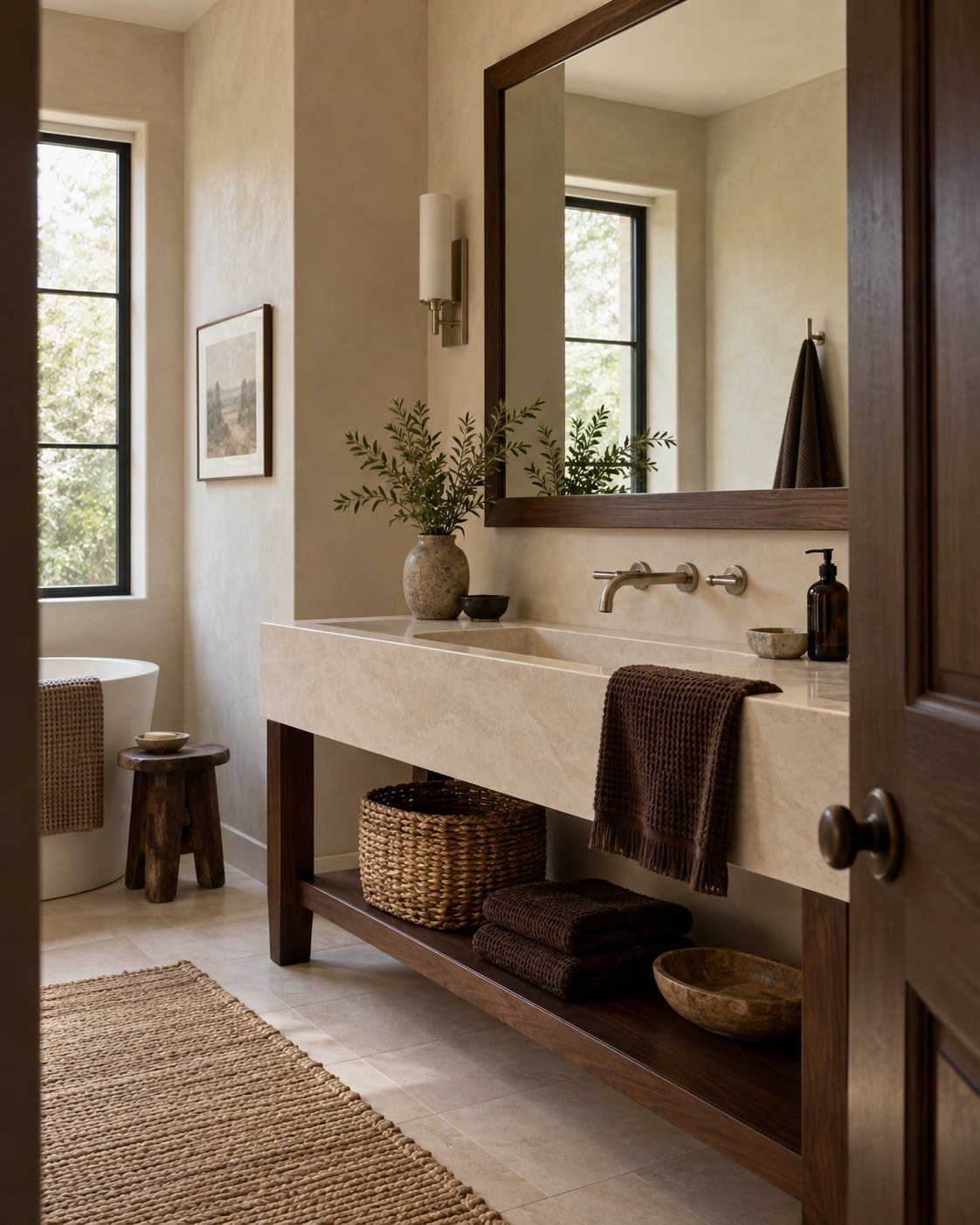
A room made entirely from pale finishes can sometimes feel unfinished. A touch of chocolate brown, dark timber or a deeper taupe gives it an outline.
Try a mirror frame, a small stool or one darker towel before considering a large change. The contrast helps lighter surfaces stand out and makes the palette feel intentional. You only need a little; repeating the dark tone in one other place is often enough to connect the room.
Place the deeper shade near something you want to define, such as the mirror or vanity. A dark frame against a pale wall gives that area a clear outline, while a brown towel on a nearby rail gently repeats the effect. Avoid spreading tiny dark accents across every corner; a couple of connected details are easier to read and make the room feel calmer.
A useful starting point: Brown can give you the definition you wanted from black while keeping the overall look softer.
11. Consider stone-look porcelain for a bigger change
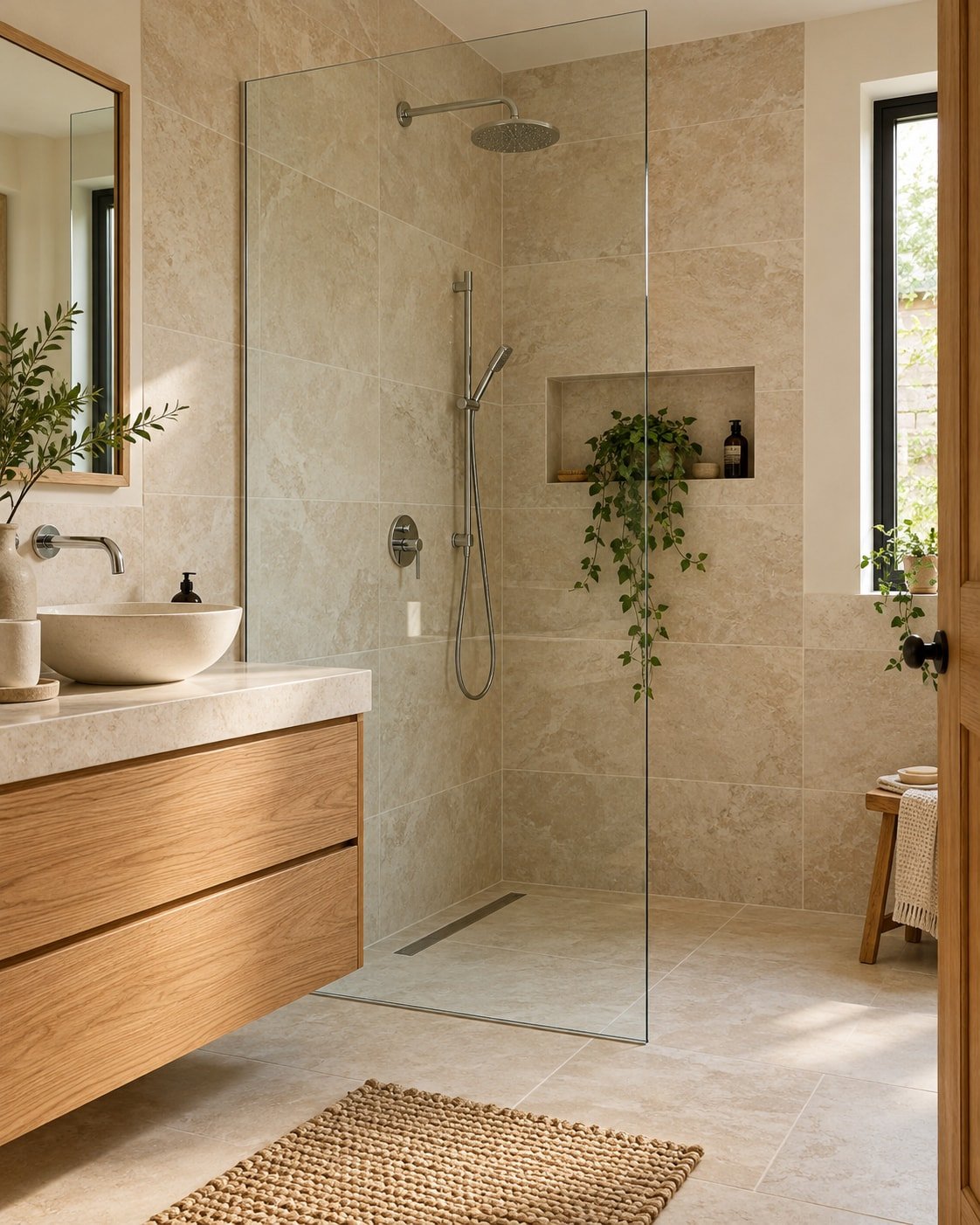
For a renovation, stone-look porcelain can bring a soft, natural-looking backdrop into a warm neutral bathroom. The best choice for your room depends on the scale of the pattern as much as the colour.
Look at a larger display or several samples so you can judge the repeat. A very busy print can feel quite different across a whole wall. Wall and floor products are not interchangeable by default; check suitability, care information and the floor’s slip-performance guidance with your supplier and installer.
Ask to see how the tile looks with the proposed grout rather than judging the two separately. A close match tends to make the surface feel more continuous, while stronger joints emphasise the layout. If your warm neutral bathroom has several changes of plane, such as a shower niche or boxed-in pipework, plan how the pattern will meet those edges before installation.
A useful starting point: Keep a sample beside the vanity finish and grout choice before placing a full order.
12. Use textiles to warm up the bathroom you already have

You can create a warmer feel without touching the tiles. A textured shower curtain, soft bath mat and a couple of well-chosen towels can change the balance of a plain white room.
Start with a small palette so it doesn’t turn into a collection of almost-matching purchases. Cream plus taupe, or oatmeal plus a little brown, is enough. Choose washable textiles, use a suitable shower liner where needed and let everything dry properly between uses. This is the easiest option to reverse if your tastes change.
Build the update around your weekly washing routine as well as the colour palette. Having a spare set of towels in a compatible shade is more practical than buying decorative pieces you rarely use. A warm neutral bathroom can still feel lived-in: leave space for the everyday bottles, a place to hang damp towels and somewhere convenient for the items you reach for each morning.
A useful starting point: Before buying more accessories, remove the things you don’t use and give the new textures some space.
How to bring your warm neutral bathroom together
A warm neutral bathroom feels good because the finishes work together, not because every surface matches. Start with what is staying, add one texture and one gentle contrast, then live with it for a while. You may find that a new towel colour and softer lighting do more than another basket of accessories.
If you are choosing paint, compare finishes intended for the room as well as colours. Dulux’s bathroom paint guidance is one manufacturer’s reference to consult alongside the preparation and application instructions for your chosen product.


